


U.S. President Donald Trump's surprising claim this week that talks with Iran were yielding great progress has only raised more confusion over a war whose goals were already unclear. The most basic question: What talks?
A 15-point plan from the Trump administration offering a potential pathway to an exit was offered late Tuesday to Iran through Pakistan, according to a person briefed on the contours of the plan but who was not authorized to speak publicly about it.
 Full Story
As Israel trades fire with Hezbollah, calls for mass evacuations and sends ground troops deeper into Lebanon, its leaders have hinted at a long-term occupation modeled on the devastating conquest of much of Gaza after Hamas' Oct. 7, 2023, attack.
Israel says it needs to establish a zone of control in the depopulated south to shield its own northern communities, which have faced daily rocket attacks since the Hezbollah joined the wider war. Many in Lebanon fear that could mean the open-ended displacement of over a million people, the flattening of their homes and a loss of territory.
 Full Story
Long before he became Iran's parliament speaker, Mohammad Bagher Qalibaf went on a charm offensive for almost two decades, portraying himself as a hard-liner the West could do business with in the Islamic Republic.
"I would like the West to change its attitude to Iran and trust Iran, and rest assured that there's an attitude in Iran to advance issues through dialogue," he told The Times newspaper of London in 2008.
 Full Story
Wall Street shot higher and global oil futures tumbled Monday after President Donald Trump extended his deadline for Iran to reopen the crucial Strait of Hormuz and said the U.S. would hold off on strikes against Iranian power plants and other energy infrastructure for five days.
Trump's post on social media about the strikes came as the war with Iran enters its fourth week. Futures for the S&P 500 and Dow Jones Industrial Average soared 2.6% before the opening bell. Oil prices also immediately reversed course, sinking as much as 10%. Benchmark U.S. crude slid $8.23 to $90 a barrel. Brent crude, the international standard, tumbled $9.02 to $103.17 a barrel.
 Full Story
A strike on a bridge Monday in the southern village of Qaaqaaiyet al-Jisr cut a main link between the southern city of Nabatiyeh and al-Hujair valley region farther south.
Israel also struck two bridges in Qasmiyeh and Matariyeh and another in Burj Rahhal linking the city of Tyre to Sidon. Other strikes on south Lebanon hit al-Qlayleh, al-Henniyeh, Jwaya, al-Tiri, Zrarieh, Hamoul, al-Bayyada, Shehabiyeh, Tebnine, Majdal Selem, Shaqra, Ainata, al-Khiam, Maroun al-Rass, and al-Rihan.
 Full Story
Benjamin Netanyahu must soon decide when to hold Israel’s next elections. With war raging on multiple fronts and no end in sight, Israel’s enemies in Iran and Lebanon may help make that decision for him.
 Full Story
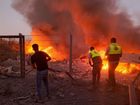
Israeli military spokesman Nadav Shoshani said Thursday that Israel has killed 500 Hezbollah fighters in its current war against the group, among them 200 from the elite Radwan unit. He gave no further evidence.
The claim came as the death toll in Lebanon topped 1,000.
 Full Story
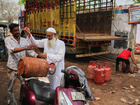
Countries in Asia are scrambling to conserve energy and protect consumers as the war on Iran and attacks on gas fields and oil refineries disrupt critical supplies, rattling markets and driving up prices.
The crisis is hitting Asia hardest because of its heavy reliance on imported energy, much of which is shipped through the Strait of Hormuz, a key choke point now under strain. Only about 90 vessels — mostly Indian, Pakistani and Chinese-flagged — have made it through the strait since the beginning of Israeli and U.S. attacks on Iran, and Iran's strikes against Israel and Gulf Arab neighbors, on Feb. 28.
 Full Story
The Pentagon is seeking $200 billion in additional funds for the Iran war, a senior administration official says.
The department sent the request to the White House, according to the official, who spoke on condition of anonymity to discuss the private information.
 Full Story
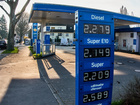
Iran intensified its attacks on oil and gas facilities around the Gulf on Thursday, dramatically raising the stakes in a war that is sending shock waves through the global economy.
The strikes, in retaliation for an Israeli attack on a key Iranian gas field, sent fuel prices soaring and risked drawing Iran's Arab neighbors directly into the conflict. Tehran's targeting of energy production further stressed global supply already under pressure because of Iran's stranglehold on the Strait of Hormuz, a strategic waterway through which a fifth of the world's oil is transported.
 Full Story


