


Spotlight
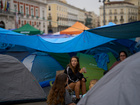
Housing protesters camped out in Madrid's most iconic square awoke from their third night in the open to await details from the Spanish government on what it's doing to tackle a crisis that has brought tens of thousands of people onto the streets in recent days.
The protests and the encampment in Puerto del Sol followed the eviction of María del Carmen Abascal, 87, who was carried out on a stretcher from the apartment where she had lived for seven decades.
 Full Story
Russia fired ballistic missiles and dozens of jet-powered drones at Kyiv, Ukraine's air force said Tuesday, as Moscow seeks to make Ukraine buckle under the pressure of day-and-night bombardment of its capital and other cities.
The Russian onslaught has used new jet-powered drones that fly too fast and too high for Ukrainian ground-based air defenses to shoot down.
 Full Story
European Union nations have spent over an extra 100 billion euros ($113.5 billion) on energy imports since the outbreak of the Iran war, pushing politicians to seek alternatives to fossil fuels as prices skyrocket.
Consumers in some European countries pay nearly 50% more at the pump, equivalent to more than $11 a gallon, following the closure of the Strait of Hormuz, the crucial waterway through which a fifth of the world's traded oil passed in peacetime.
 Full Story
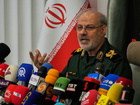
Gen. Hossein Mohebbi, spokesman for the Revolutionary Guard, held a news conference dubbed “A letter to the American people” in Tehran, Iran's capital.
He said that the only way for the war to end is for Washington to admit defeat and leave — a message apparently meant for the U.S. public just weeks ahead of the Nov. 3 midterm elections for the U.S. Senate and Congress.
 Full Story
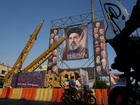
Iran's currency fell to a new record low on Tuesday, with traders in Tehran exchanging more than 2.5 million rials to the U.S. dollar in a stark reflection of how the war in the Middle East has steadily eroded the Iranian economy.
The latest decline came just 27 days after the rial hit its previous record low of 2.2 million to the dollar on Sept. 2. The currency has repeatedly reached new lows since the war began in February.
 Full Story
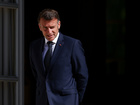
French President Emmanuel Macron denounced a "dangerous escalation" by Russia after Estonia accused it of being behind an August arson attack on a drone manufacturer.
"The multiplication of these hostile acts represents a dangerous escalation by Russia, which will only lead it into a dead end," Macron said, recalling a recent incident in Germany where an explosive-laden drone was found near an airport.
 Full Story
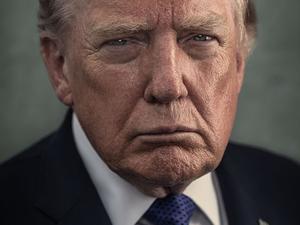
U.S.-Canada relations, already tense, are likely to deteriorate further after the United States went ahead early Tuesday with a decision to ban nearly $1 billion worth of Canadian imports, including alcoholic beverages, dairy products and motorcycles.
The ban amounts to barely a ripple in $880 billion worth of a two-way annual trade between the two northern neighbors. But it marks another ratcheting up of President Donald Trump's second-term trade war with America's longtime ally and trading partner.
 Full Story
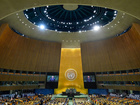
There is doom. There is gloom. There is mistrust. There is insistence upon shared power and the prevention of political and military bullying. And there is a growing cry for permanent seats at the table of power — for island nations threatened by climate change and, more than anything, for Africa.
These things have often been true in recent years when world leaders orate at one another during their annual meeting at the U.N. General Assembly, which concluded Monday. This year, though, the discourse seemed even more urgent than usual. Across the words of more than 150 speeches, two things emerged as clear: Many leaders deeply want the world body to work. And many have concluded that it isn't.
 Full Story
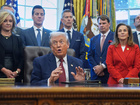
The Trump administration released new fuel economy standards Monday that relax regulatory requirements for automakers to control pollution from gasoline-powered cars and light trucks.
Fuel economy requirements set out how far new vehicles need to travel on a gallon of gasoline. The change furthers President Donald Trump's promise to revoke policies that encouraged or created incentives for the production of electric vehicles.
 Full Story
Iran’s supreme leader, Ayatollah Mojtaba Khamenei, has praised his country’s fighters for allegedly preventing "enemy forces" from "roaming freely" in the Strait of Hormuz.
Khamenei said in a message carried by the state broadcaster on Monday that Iran’s enemies now "do not come" closer to the strait than the Arabian Sea, which is part of the Indian Ocean.
 Full Story


