


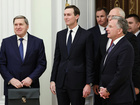
A White House envoy said he held "productive and constructive" talks in Florida with Ukrainian and European representatives to end the nearly four-year war between Russia and Ukraine.
Posting on social media on Sunday, Steve Witkoff said the talks aimed at aligning on a shared strategic approach between Ukraine, the United States and Europe.
 Full Story
A Russian general was killed Monday morning after an explosive device detonated underneath his car in southern Moscow, investigators said.
Lt. Gen. Fanil Sarvarov, head of the Operational Training Directorate of the Russian Armed Forces' General Staff, died from his injuries, Svetlana Petrenko, official spokesperson for Russia's Investigative Committee, said.
 Full Story
North Korea said on Sunday that Japan's nuclear ambitions "must be prevented at any cost", after a Tokyo official reportedly suggested the country should possess atomic weapons.
 Full Story
The Kremlin on Sunday denied that three-way talks between Ukraine, Russia and the United States were on the cards, as diplomats gathered in Miami for talks on ending the conflict.
 Full Story
Russian envoy Kirill Dmitriev said on Saturday he was heading to Miami, where another round of talks to settle the Ukraine war is set to take place.
 Full Story
Turkey said a drone that crashed on Friday in a rural area of northwestern Turkey following a series of incidents linked to the Russia-Ukraine conflict was of Russian origin.
 Full Story
U.S. President Donald Trump asserted Thursday he does not need congressional approval to launch strikes on land against Venezuela despite criticism that he is already exceeding his constitutional authority with attacks at sea.
 Full Story
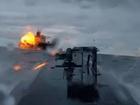
Ukraine said Friday it had hit a Russian "shadow fleet" tanker with aerial drones in neutral waters of the Mediterranean Sea, its first strike there in the nearly four-year war.
 Full Story
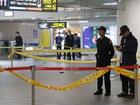
Attacks at metro stations in Taipei on Friday involving smoke bombs and stabbing killed at least three people, the fire department official said, adding that the suspect was also dead.
 Full Story
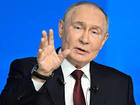
Russia's Vladimir Putin on Friday said the ball was in the court of the West and Kyiv in talks to end the war in Ukraine, while hailing Moscow's recent battlefield gains and threatening more.
Speaking during his annual end-of-year news conference -- a staple of his 25-year rule -- Putin told Russians that Moscow was intent on pressing on in Ukraine, striking a confident tone.
 Full Story


