


Two Koreas Hold Rare High-Level Talks
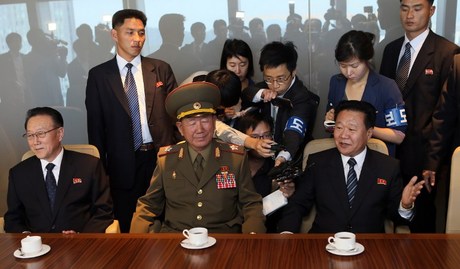
North and South Korea were set to hold rare, high-level talks Friday, with each side looking to wrestle concessions from the other on stalled cross-border programs in which both their leaders have a political stake.
The vice minister-level dialogue, held in the Kaesong joint industrial zone on the North Korean side of the border, is the fruit of crisis talks in August to ease sky-high military tensions on the divided peninsula.
The last such sit-down, with the mandate to discuss a range of inter-Korean issues, took place nearly two years ago.
"The outcome this time could have a significant impact on the path the overall inter-Korea relationship takes next year," said Cheong Seong-Chang, an analyst at the Sejong Institute think-tank in Seoul.
Although any talks between the two Koreas are welcomed as a positive step, precedent suggests any significant breakthrough is unlikely.
Previous efforts to establish a regular dialogue have tended to falter rapidly after an initial meeting -- a reflection of the deep mistrust between two countries that have remained technically at war since the end of the 1950-53 Korean conflict.
One effort to resume the high-level talks in June 2013 collapsed before they even began, after the North took offense at the rank of the chief delegate nominated by Seoul.
Due to head the South's side at Friday's talks was Hwang Boo-Gi, deputy head of Seoul's Unification Ministry, which handles cross-border affairs. His counterpart was Jon Jong-Su, a vice director of the North's Committee for the Peaceful Reunification of Korea.
There was no set agenda, but both sides have clear, if not necessarily complementary priorities.
- Different priorities -
The cash-strapped North wants the South to resume lucrative tours to its scenic Mount Kumgang resort, which Seoul suspended in 2008 after a female tourist was shot dead by a North Korean guard.
Restarting the tours would be a useful propaganda victory for North Korean leader Kim Jong-Un, as well as providing a source of much-needed hard revenue.
"Kim needs to shower party and political officials with gifts and boast (about) national wealth to his people," said Nam Sung-Wook, professor of North Korean Studies at Korea University.
"He also needs cash to complete a batch of recent and on-going construction projects."
South Korea, meanwhile, wants the North to agree to regular reunions for families separated by the Korean War.
Currently the reunions are being held less than once a year and with only a very limited number of participants -- despite a huge waiting list of largely elderly South Koreans desperate to see their relatives in the North before they die.
For South Korean President Park Geun-Hye, who came to power with pledges of closer engagement with Pyongyang, a deal on the reunions would represent a welcome feather in her cap.
Park has repeatedly talked up the prospect of eventual Korean re-unification, but has offered little in terms of policy to ease tensions with the perennially belligerent North.
With only two years left until the end of her term, Cheong said Park was "running out of time" to try and build a legacy when it comes to inter-Korean relations.
The elephant in the room for any North-South dialogue is Pyongyang's nuclear weapons program. But while Seoul may well raise the issue of denuclearization, experts said the two sides were likely to focus on more achievable targets.
"The North's denuclearization needs to be seen as the ultimate goal of inter-Korea dialogue, not a pre-condition of it," said Kim Keun-Shik, a professor at the University of North Korean Studies in Seoul.
