


Houthis seize more key islands in southern Red Sea, tighten grip on shipping routes
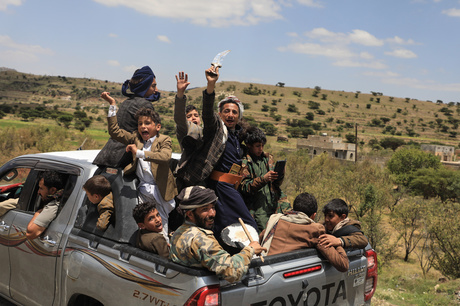
Yemen's Iran-backed Houthi rebels captured more strategic islands in the southern Red Sea, government and Houthi officials said Monday, strengthening their control of a major maritime shipping route.
The capture of the islands of Greater and Lesser Hanish is the latest in the rebels' swift advance around the Bab el-Mandeb Strait, a key passage for Saudi oil shipments that has only become more crucial during the Iran war since it serves as an alternative to the Strait of Hormuz.
Like Hormuz, which is located at the mouth of the Persian Gulf, the Bab el-Mandeb Strait — on the opposite side of the Arabian Peninsula — is a chokepoint that connects the Red Sea to the open ocean and Saudi Arabia's key Asian markets.
For more than a month, the Houthis have been striking Saudi oil infrastructure and shipping in the Red Sea, stepping up pressure on global oil prices and boosting Iran's leverage in its war with the United States.
Saudi-backed Yemeni government forces have been attempting to rally and fight back. But the Houthi gains have seemingly come with little resistance.
The rebels deployed on the Hanish islands, 160 kilometers (100 miles) north of Bab el-Mandeb, after hundreds of government-allied forces withdrew from the archipelago, according to two government officials and a Houthi official. The officials spoke on condition of anonymity because they were not authorized to talk to journalists.
The capture of the islands came after the rebels last week seized the port city of Mokha on the mainland nearby and the island of Mayun, inside the Bab el-Mandeb Strait. The Houthis' advances also put them just 20 miles (32 kilometers) from the U.S. military base in Djibouti, on the other side of the Bab el-Mandeb Strait.
Thousands of Yemenis are fleeing the fighting
The fighting is pushing in the impoverished nation back into full-fledged civil war, after a truce that largely maintained quiet since 2022. Even as they advance along the Red Sea, the Houthis have waged an offensive further inland, particularly in the longtime battleground province of Taiz.
Some 150 civilians have been killed in fighting since Sept. 3, including a pregnant woman killed Saturday in a village in Taiz, the government's Human Rights Ministry said. More than 200 civilians have been wounded, it said.
Thousands of families have fled their homes in Taiz and nearby provinces in the past day along, said Khanzad Shah, acting head of Islamic Relief, a charity that operates in the area.
"Many of them don't have enough food or water as they had to flee with whatever they could carry. In some areas, whole villages have reportedly emptied," he said.
The United Nations has estimated that more than 80,000 people have been displaced in the past two weeks, including over 2,000 people who fled by boat to Djibouti.
The fighting threatens to reignite a war that for more than a decade brought disaster to Yemen, killing more than 150,000 people and driving the country to the brink of famine. Since 2014, the Houthis have controlled the north, including the capital, Sanaa, and much of the western heartland of the country where most of the population is located.
The internationally recognized government, backed by an array of disparate militias, controls the south and east, including the key southern port of Aden.
The Hanish islands, newly captured by the Houthis, had been controlled by the United Arab Emirates and its southern allies in Yemen. However, the UAE dismantled its military infrastructure there after it fell out with Saudi Arabia and the Yemeni government earlier this year.
For years, Saudi Arabia waged a destructive air campaign against the Houthis, while backing the government and allied militias. But it has appeared reluctant to throw itself fully back into the war, despite the Houthi attacks on oil infrastructure and shipping.
Houthi cross-border attacks are continuing
Saudi authorities sounded sirens on Sunday afternoon in the southern city of Abha and Khamis Mushait province, warning residents to take shelter from potential incoming fire. Both areas, near the border with Yemen, were repeatedly attacked by the Houthi in recent weeks.
A Houthi spokesman said they fired dozens of missiles and drones at the King Khalid Air Base in Khamis Mushait, targeting hangars, radar installations and ammunition depots. The statement on Monday by Brig. Gen Yahya Saree did not specify when the attack took place, but the Houthis often take hours or days to claim responsibility for attacks.
There was no immediate comment from Saudi Arabia on the Houthi claim. The Saudi civil defense overnight said a projectile fell in a different area near the border with Yemen along the Red Sea, injuring two people and damaging a mosque and several other buildings. The statement blamed the Houthis.
Saudi Arabia did not announce any new attacks targeting the Houthis.
Yemeni government forces are trying to regroup
On Sunday, the Yemeni government's military said it launched airstrikes on Houthi positions in the port city of Mokha, the coastal town of Dhubab and elsewhere in Taiz province. The rebels reported strikes by the Saudi-backed forces in Taiz province and artillery shelling in Saada province, a Houthi stronghold on Yemen's northern border with Saudi Arabia.
Sultan al-Arada, a member of the government's presidential leadership council, described the collapse of government forces in Mokha, about 80 kilometers (50 miles) from the Bab el-Mandeb Strait, and elsewhere on Yemen's west coast as "painful and regrettable."
He said in televised interview aired late Saturday that forces "are currently regrouping and will return to the battle."
On Sunday, Rashad al-Alimi, who leads the presidential council, sought to downplay the defeats as "incidental," according to comments published by the country's state-run SABA news agency. The government, he said, "will remain clear and fixed on the goal of retrieving (state) institutions and of reclaiming sovereignty over all national territories."
People fleeing the Houthi advance told The Associated Press they saw forces withdrawing and urging people to run.


