


Multiple coordinated airstrikes hit Beirut and its suburbs
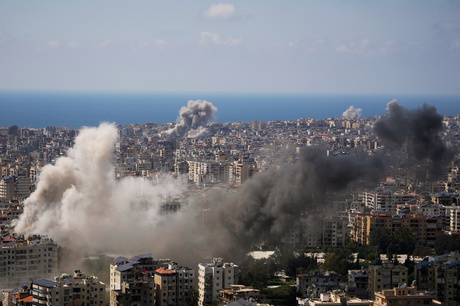
Israel launched a series of strikes on Beirut on Wednesday, hitting several parts of the capital as well as its southern suburbs.
Loud booms could be heard throughout the city and smoke was rising from several points.
Several of the strikes were in busy commercial and densely populated locations, without warning.
The strikes came hours after a ceasefire was announced in the U.S.-Israeli war with Iran. Israel has said the agreement does not extend to Lebanon, although mediator Pakistan said it does.
The strikes targeted Barbour, Burj Abi-Haydar, Corniche al-Mazraa, Ein al-Mraysseh, al-Manara, Msaytbeh, Ain el-Tineh, al-Basta and Beer Hassan in Beirut. Other strikes targeted Burj al-Brajneh, Hay al-Sellom and Haret Hreik in Dahieh and other regions across Lebanon including Kayfoun, Bshamoun, Souq al-Ghareb, Aramoun, Chweifat and south and east Lebanon.
The Israeli military said it struck around 100 sites across Lebanon in ten minutes, describing the operation as the "largest coordinated strike" since the war with Iran began.
The health ministry issued an emergency call for people to clear roads in Beirut for ambulances after the series of strikes on the capital.
In a statement, the ministry said it was "urgently calling on citizens to clear the way for ambulances so they can carry out their work".
"The traffic congestion caused by the unprecedented wave of airstrikes launched by the Israeli enemy is hindering rescue efforts," it said.
Before the wave of new strikes, a Hezbollah official told The Associated Press that the group was giving a chance for mediators to secure a ceasefire in Lebanon, but "we have not announced our adherence to the ceasefire since the Israelis are not adhering to it." He spoke on condition of anonymity because he was not authorized to comment publicly.
The Hezbollah official said the group will not accept a return to the pre-March 2 status quo, when Israel carried out near-daily strikes in Lebanon despite a ceasefire being nominally in place since the last full-blown Israel-Hezbollah war ended in November 2024.
"We will not accept for the Israelis to continue behaving as they did before this war with regards to attacks," he said. "We do not want this phase to continue."
 08 April 2026, 14:55
00
08 April 2026, 14:55
00
The Israeli air force needs to keep busy, now that they have a ceasefire with Iran!!!!!
 08 April 2026, 15:24
00
08 April 2026, 15:24
00
Bravo IDF…hit 100 CIVILIAN TARGETS AND INNOCENT DEFENSELESS HUMANS IN 10 minutes. Bravo bravo for the extremely peaceful gestures from our neighbor…history will reward you…BRAVO
 09 April 2026, 19:24
00
09 April 2026, 19:24
00
Nope. Hezbollah was having a zoom meeting. Israel made sure that they zoom out of here real quick to keep Hassouna company.

