


Is Israel replicating Gaza's 'Yellow Line' in south Lebanon?
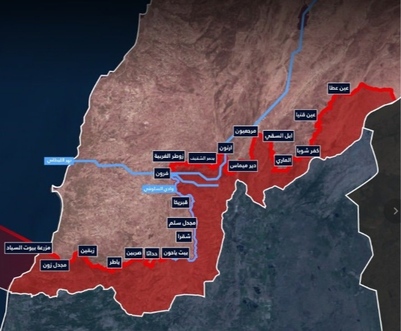
Israel says it has established a "Yellow Line" in south Lebanon near the border, where its forces are operating despite a 10-day ceasefire with Iran-backed Hezbollah.
What is the so-called "Yellow Line", how does it resemble an Israeli military demarcation in the Gaza Strip and where does it leave Lebanon?
- What has Israel announced? -
Israeli Prime Minister Benjamin Netanyahu said Israel agreed to the truce, which took effect on Friday, but would maintain a 10-kilometer (six-mile) deep "security zone" along the border in southern Lebanon.
On Saturday, Israel's military announced a "Yellow Line" in the country's south.
The following day, it published a map identifying a "forward defense line", stretching from the Mediterranean in the west up to Lebanon's border with Syria in the east.
It said "five divisions, alongside Israeli navy forces" were operating in the area to dismantle Hezbollah infrastructure and "prevent direct threats to communities in northern Israel."
The area includes frontier villages that were destroyed or heavily damaged after a previous round of hostilities erupted between Israel and Hezbollah in 2023.
Most locals have fled the area, though residents of some Christian villages have been defying Israeli army evacuation orders.
U.N. peacekeepers are also stationed there.
On Monday, Israel's military warned Lebanese civilians against returning to dozens of villages south of the "forward defense line", claiming Hezbollah's activities in the area were violating the ceasefire.
Israeli troops have been destroying buildings in border towns since the truce began.
Israel has repeatedly tried to create a buffer zone in southern Lebanon.
In 2000 after persistent pressure from Hezbollah, Israeli troops withdrew from Lebanese territory after some two decades of occupation.
- Similar to Gaza? -
In Gaza, the "Yellow Line" refers to an Israeli military demarcation established during an October 2025 ceasefire with Palestinian militant group Hamas, creating a de facto boundary inside the Palestinian territory.
It effectively splits Gaza between an area under direct Israeli military control where Palestinians are not permitted, and a Hamas-governed area where residents remain vulnerable to Israeli strikes.
The line has reshaped daily life for Gazans and prevented tens of thousands of displaced Palestinians from returning home.
Israel's military regularly says it has targeted individuals it describes as militants approaching the line in Gaza, and has begun doing the same in Lebanon.
Lebanese military expert Hassan Jouni told AFP that "the Yellow Line in Lebanon is a copy of the idea and philosophy of the Yellow Line in Gaza", even bearing the same name.
In Gaza, however, the line was "the result of an agreement with Hamas. In Lebanon, there is no agreement... it was decided unilaterally" by Israel, he said, calling it "an aggressive decision."
The line represents a new Israeli security border, a defensive line "that will certainly be fortified" to protect northern Israel's towns and villages, and potentially "a line for launching new offensive operations", he added.
It creates "a so-called free-fire area, like in Gaza, where any activity... is considered suspicious and justifies opening fire".
- What options does Lebanon have? -
President Joseph Aoun said Monday that planned direct talks with Israel aimed to end hostilities and Israel's occupation in the south.
Under the truce terms, which do not mention an Israeli withdrawal from Lebanon, Israel reserves the right to continue targeting Hezbollah to prevent "planned, imminent or ongoing attacks."
Israeli forces never fully withdrew after the last war, despite being required to under a November 2024 ceasefire.
Hezbollah strongly opposes the planned negotiations and has also called on Israeli troops to withdraw, decrying what it sees as Israeli expansionism.
Hezbollah lawmaker Hassan Fadlallah told AFP on Monday that "we will bring down this Yellow Line through the resistance (Hezbollah), with our insistence on our legitimate right to defend ourselves and our country."
He vowed that Israel would be unable to set up any buffer zone in south Lebanon, and that Hezbollah would drive out Israeli troops if they stay "on any inch of our territory."
Jouni said the "Yellow Line" would be a flashpoint for "political confrontation firstly, and a military confrontation by Hezbollah".
He said he expected to see both "a political path that starts with the negotiations", and an approach on the ground "that will be decided according to the regional situation... between Iran and America."
"Maybe U.S. President Donald Trump will surprise everyone by pressuring Israel to withdraw" from Lebanon, Jouni added.


