


Israeli strikes kill 4, wound 51 in south Lebanon
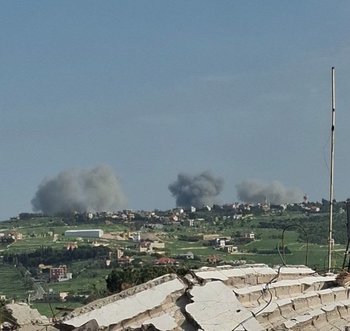
Israeli Prime Minister Benjamin Netanyahu said Hezbollah's rockets and drones were a key threat demanding military action, as Israel's army expanded strikes on Lebanon where authorities reported four dead on Monday despite a ceasefire.
Lebanese President Joseph Aoun said direct talks with Israel sought to end the Israel-Hezbollah war and that those who dragged Lebanon into it were the ones committing "treason" -- a jab at the Iran-backed group, which claimed several attacks on Israeli targets in south Lebanon on Monday.
Hezbollah chief Sheikh Naim Qassem called direct talks between the two countries a "sin", while Israeli Defense Minister Israel Katz warned the group's rejection of negotiations would bring catastrophic consequences for Lebanon.
Israeli and Lebanese representatives met twice in Washington this month, the first such meetings in decades, for discussions that Hezbollah has categorically rejected.
After the first talks, U.S. President Donald Trump announced a 10-day ceasefire that began on April 17, and a three-week extension after the second round.
Netanyahu said in a statement that "there are still two central threats from Hezbollah: the 122mm rockets and the drones. This demands a combination of operational and technological activity."
Israel's army said it struck more than 20 Hezbollah "infrastructure sites" in eastern Lebanon's Bekaa Valley and the country's south on Monday, including weapons storage facilities and rocket launch sites.
Under the ceasefire, Israel reserves the right to act against "planned, imminent or ongoing attacks".
- 'Grave sin' -
Lebanese state media reported Israeli airstrikes in multiple locations in south Lebanon, including around a dozen sites in the evening.
The health ministry said Israeli strikes on the south killed four people on Monday, including a woman, and wounded 51 others.
Israeli strikes have killed at least 40 people in Lebanon since the truce began, according to an AFP tally of health ministry figures.
Hezbollah said its fighters launched several attacks on Israeli troops, including on an army bulldozer that it said was demolishing homes in the border town of Bint Jbeil.
Aoun said in a statement that "my goal is to reach an end to the state of war with Israel, similar to the armistice agreement" of 1949, signed after the 1948 Arab-Israeli war.
"I assure you that I will not accept reaching a humiliating agreement," said Aoun.
Earlier, Hezbollah's chief sharply criticized the government, branding direct negotiations with Israel a "grave sin".
"We categorically reject direct negotiations with Israel, and those in power should know that their actions will not benefit Lebanon or themselves," Qassem said in a statement.
He urged authorities to "back down from their grave sin that is putting Lebanon in a spiral of instability".
The government "cannot continue while it is neglecting Lebanon's rights, giving up land, and confronting" those resisting Israel, he said.
"We will not give up our weapons... and the Israeli enemy will not remain on a single inch of our occupied land."
Israeli troops who invaded south Lebanon after the war erupted on March 2 are operating inside an Israeli-announced "yellow line" -- a ribbon of Lebanese territory around 10 kilometers deep along the border, where Lebanese have been warned not to return.
- 'Consensus' -
Aoun said that "what we are doing is not treason. Rather, treason is committed by those who take their country to war to achieve foreign interests".
Aoun has faced intense criticism from Hezbollah and its supporters.
They say his push for direct talks with Israel lacks consensus among Lebanon's communities -- the latest point of contention after the government decided to disarm the group last year and outlawed its military activities in March.
"Some want to hold us accountable over the decision to go to negotiations on the grounds that there is no national consensus" over the talks, Aoun said.
"My question to them is: when you went to war, did you first obtain national consensus?"
Hezbollah drew Lebanon into the Middle East war by firing rockets towards Israel to avenge the killing of Iranian supreme leader Ali Khamenei in U.S.-Israeli strikes.
Katz said Qassem was "playing with fire, and the fire will burn Hezbollah and all of Lebanon".


